
My firm is regularly contacted by Portuguese citizens who are French tax residents and face tax adjustments and fines for failing to report bank accounts opened in Portugal. The French tax authorities appear to be conducting a campaign to check declarations, or their absence, concerning accounts held by Portuguese nationals reporting their income in France. Article 1649 A, paragraph 2, of the General Tax Code (CGI) requires foreign accounts to be reported: “Individuals, associations and companies not having a commercial form, domiciled or established in France, must declare, together with their income or profit return, details of accounts opened, held, used or closed abroad. The implementing arrangements are determined by decree.”
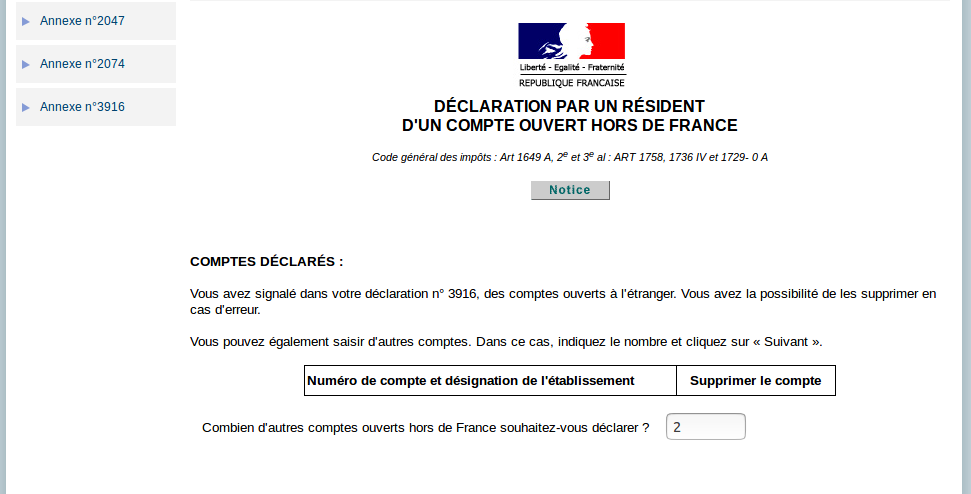
Articles 344 A and 344 B of annex III to the CGI set out the implementing rules. In practice, bank details must be reported in annex no. 3916 to income tax return no. 2042. Annex no. 3916 Bis concerns digital asset accounts opened, held, used or closed abroad. Account balances are not part of the information to be disclosed. An account is considered to be held by a taxpayer who is its holder, joint holder, economic beneficiary or person entitled to its economic benefits.
Penalties can grow exponentially: a fine of 1500 € applies per account for each undeclared year. According to the authorities, reassessment can extend back ten years. Amounts, securities or assets transferred abroad or from abroad through accounts not declared under Article 1649 A, paragraph 2, of the CGI are also presumed taxable income unless proved otherwise. Beyond fines, taxpayers can therefore be reassessed on money passing through their Portuguese account if they cannot establish a lawful origin and rebut the legal presumption of tax fraud.
Portuguese people who are French tax residents are strongly advised to pay close attention to account reporting and voluntarily correct any omission in order to rely on good faith, even though the authorities dispute correction without fines. A good-faith correction should fall within the spirit of the right to make a mistake confirmed by Law no. 2018-727, known as the ESSOC law. Administrative guidance expressly states that this right predates the law: under the CGI and the tax procedures code, taxpayers who spontaneously file an amended return to correct a good-faith error face no surcharge or fine in the vast majority of cases.
It may fall to the administrative courts to recognise this right to make a mistake, which seems relevant here. Another issue is whether failure to file annex no. 3916 by someone who has declared their income is a failure to declare or an error in the return. The answer will affect the limitation period. In conclusion, the Portuguese community should be alerted to this obligation and encouraged to correct matters promptly. It would also be useful for Portuguese banks opening accounts in Portugal for non-Portuguese residents to remind clients of this French reporting obligation as part of their duty to advise.
Dr. Pedro Emanuel de OLIVEIRA
Lawyer